
Digital Resilience in SaaS #01: CRM & ERP Integration
Exploring how CRM and ERP integration builds digital resilience, enabling organizations to thrive during economic disruption by connecting Salesforce and NetSuite.
Anthony Wong
May 14, 2024
Introduction
Propelled by ongoing global events, business interactions worldwide are ever more remote and digital. Add economic turbulence and today’s dynamic economic environment, characterized by unprecedented challenges and opportunities, is compelling organisations of all sizes to reassess their strategies, tighten budgets, and streamline operations for greater efficiency.
Many companies are responding by actively condensing their software stacks. Leaders across every industry vertical are seeking solutions that go beyond helping them weather uncertain times. Rather, they are investigating options that support true digital resilience – seeking to thrive, not just survive, in the face of adversity.
In particular, companies are paying renewed attention to their most fundamental IT systems: Customer Relationship Management (CRM) in the front office and Enterprise Resource Planning (ERP) in the back. As winners and losers will increasingly be defined by how well they can extract value from these two domains, it’s critical for organisations to integrate these systems efficiently and effectively. This integration enables the fast, secure, and compliant information sharing that empowers business users to do more with less.
Until now, enterprises with the SaaS solutions Salesforce, for CRM, and NetSuite, for ERP, lacked a comprehensive, vendor-neutral resource for understanding the general integration opportunities and challenges as well as gaining a detailed and actionable roadmap for strategically, efficiently, and cost-effectively deploying an integration solution that is the right fit. Regardless of your business size or type, this whitepaper sets out to fill that gap.
CRM & ERP Integration: Making the Case
As enterprises take a more discerning approach to technology investments, emphasizing not just growth but also fiscal responsibility, the C-suite’s focus on value realization and cost optimization has never been more acute. This requires IT departments to take a strategic approach to software adoption that aligns with a company’s overarching business and financial goals.
Digital Resilience as a Strategic Imperative
A company’s ability to withstand and adapt to external economic and technological shocks is known as digital resilience. In a world that is increasingly defined by uncertainty, companies with a high level of digital resilience are proven to significantly outperform their non-resilient peers. In fact, recent research by McKinsey demonstrates that digitally-resilient companies have exceeded the returns of their non-resilient counterparts by nearly 165%. This underscores the critical role that digital resilience plays in determining organizational success in an era where adaptability is not just an advantage, but a necessity.
More Than the Sum of Their Parts
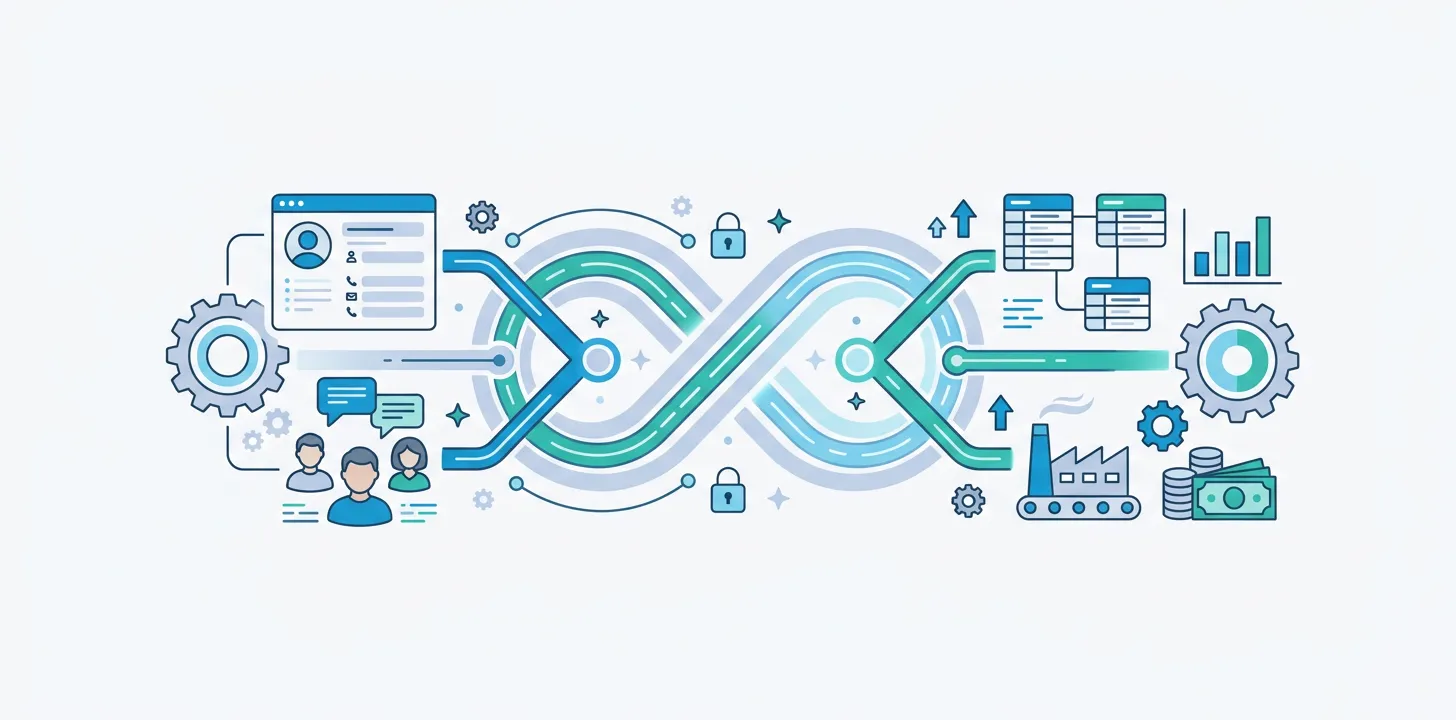
As CRM and ERP are the two powerhouses in every enterprise that drive operational effectiveness and play a pivotal role in shaping digital resilience, leading companies are now moving beyond utilizing them as distinct systems to interconnecting them.
Consider the example of an enterprise that integrates Salesforce and NetSuite. The company can increase revenues by enabling salespeople to use Salesforce for viewing customer payment history, which is generated by NetSuite. This provides a data-driven means for determining which customers would be the best targets for upselling or cross-selling.
At a more advanced level, this same company can adopt Salesforce AI tools that predict a specific customer’s propensity to stay current on payments. This is calculated using data extracted from NetSuite across all customers. Further, salespeople can use the same tools for running more complex modeling that results in closing more targeted – and successful – deals.
Overall, the benefits from integrating Salesforce and NetSuite can dramatically increase business value of each system separately.
Streamlines Data Flow between CRM and ERP systems, ensuring information is accurate and up-to-date in both platforms.
Increases Efficiency and Reduces Risk by automating multiple processes, freeing employees from error-prone manual tasks and enabling them to focus on more value-added projects.
Enhances Visibility with holistic, real-time customer views, improving decision-making and enhancing customer service.
Tightens Sales and Marketing Alignment as sales teams can access marketing data within Salesforce for improved targeting.
Improves Customer Experiences by enabling sales, customer service, and other teams to deliver personalized, seamless, and consistent customer interactions.
Boosts Financial Reporting and Analysis by automatically reflecting financial data from sales transactions in the ERP system, providing insights into revenue, profitability, and other key financial metrics.
Contributes to Business Scalability as seamless data flow and process automation supports increased sales volumes, enables serving a larger customer base, and reduces various operational costs.
A Framework for Solution Evaluation
Selecting the Right SaaS CRM & ERP Integration Method
Like any successful technology initiative, the first step to realizing the potential from integrating Salesforce with NetSuite is selecting the appropriate integration solution. Although this may seem remedial, the data shows otherwise.
In fact, the latest research suggests that approximately a third of enterprise expenditures on SaaS initiatives constitutes overspend2, resulting business burdens that include financial, operational, and compliance challenges. Typically, overspending also causes insufficient technology adoptions, which can lead to unnecessary operational downtime and associated increases in business risk.
2Flexera 2023 State of ITAM Report, Flexera, June 13, 2023.i
Buy, Build, Invent Through CRM + ERP Lens
To gain the benefits from integrating CRM and ERP, without falling into the trap of overspending, it’s critical to decide which of the traditional technology deployment methods is appropriate for your company. Known as “Buy, Build, or Invent,” let’s start by examining each deployment method, including their inherent pluses and minuses, in the context of the available options for integrating Salesforce and NetSuite.
Buy: Native Solution
By providing a robust, purpose-built foundation to integrate Salesforce and NetSuite, Native Solutions are attractive for streamlining integrations, reducing development overhead, accelerating time-to-value, and ensuring industry best practices are followed. Such approaches tend to be proven, fast and predictable. The best solutions in the category also offer a minimum of 90 percent of the features you’ll need right out of the box (OOTB). In addition, the best of breed in this category are also both customisable and extensible. This makes them highly adaptable as thy can be “extended” (customized, scaled, or both) to meet your specific needs. Further, such solutions are evolved continuously, which helps to avoid acquiring technical debt.
Still, turnkey intermediary solutions aren’t engineered to meet the needs of every enterprise, as they are typically intended for interconnecting only two solutions, in this case your Salesforce CRM and NetSuite ERP. However, this simplicity makes them an excellent choice for starting your evaluation process, enabling you to determine whether this category of solution is sufficient or if your needs require an evaluation of the “Build” or “Invent” categories.
Build: iPaaS Intermediary Solution
For situations with integration requirements that surpass a purpose-built solution, an Integration Platform as a Service (iPaaS) can be a good fit. An iPaaS is typically pursued for either multi-point initiatives, where CRM and ERP are only two of the needed integrations, or situations requiring exceptionally deep customizations. Through low-code or no-code features, iPaaS solutions empower organizations to rapidly design and build highly-customized integrations.
Unsurprisingly, with high levels of customization comes added complexity. This typically means longer development cycles, potentially delaying time-to-market for various business functionalities. Additionally, as organizations delve deeper into customization, there is the risk of unintentionally deviating from best practices, potentially compromising the stability and maintainability of the resulting CRM and ERP integration. Furthermore, the reliance on low-code or no-code features may inadvertently introduce technical debt, making future modifications and enhancements more involved.
Invent: Custom Development
As the most costly and complex option, Custom Development is typically the least preferred method for creating an intermediary between SaaS solutions.
Custom code, while providing the ultimate flexibility, carries the usual substantial disadvantages. These include hiring custom developers, dependence on development resources for ongoing maintenance, and updating integrations continuously as the CRM and ERP solutions evolve. The inherent complexity of custom code also renders the developments more prone to brittleness and operational fragility. In the context of digital resilience and cost-effectiveness, custom development is often avoided due to the favorability of alternatives.