
The Connectivity Gap: Why Only 29% of Business Apps Are Integrated
With only 29% of business apps integrated, most organizations face costly silos. Learn why the connectivity gap persists and how native Salesforce-ERP integration closes it.
Rohan Sharma
October 8, 2025
[et_pb_section][et_pb_row][et_pb_column type=“4_4”][et_pb_text]
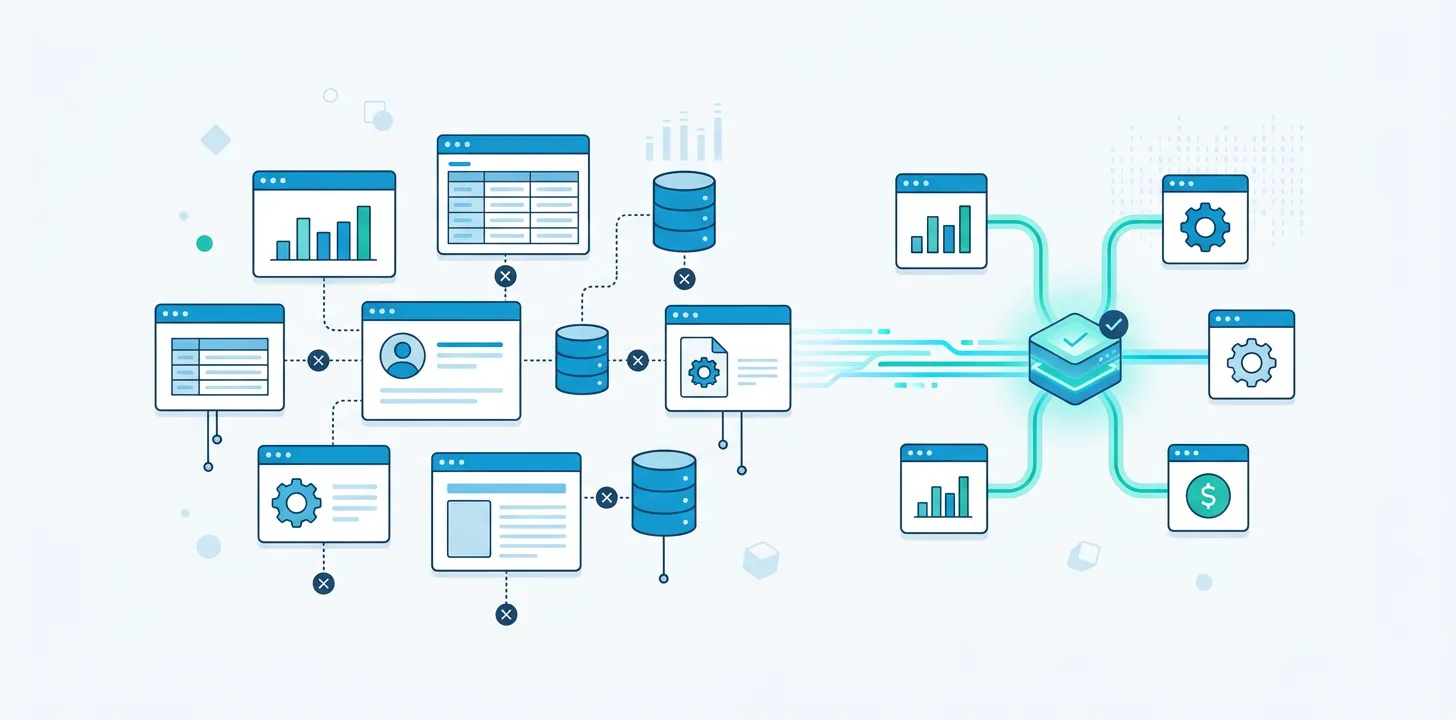
In today’s hyper-connected world, businesses rely on an ever-growing number of apps to run everything from sales and marketing to finance and operations. Yet according to Salesforce’s latest MuleSoft Connectivity Benchmark Report 2025, only 29% of business applications are integrated. That means more than two-thirds of systems sit in silos, creating delays, duplicate work, and missed opportunities.
95% of IT leaders also admit they struggle to integrate data across systems (Salesforce 2025 Connectivity Report), you know this isn’t just a technical nuisance. It’s a strategic business problem that slows down transformation, undermines AI adoption, and costs money, time, and trust.
So why is connectivity still so elusive, and what can leaders do about it?
In this article, you’ll learn:
- Why the connectivity gap persists
- How it undermines AI, automation, and decision-making
- What business leaders can do about it
- Why Breadwinner is uniquely positioned to help
1. The Scale of the Problem: Businesses Are Drowning in Apps
Businesses Are Drowning in Apps
The average enterprise now uses 1,100+ applications, but only a fraction of them talk to each other. MuleSoft found that 95% of IT leaders struggle to integrate data across systems, with nearly 40% of developer time spent building or maintaining custom integrations (MuleSoft blog).
These numbers highlight a growing paradox: companies invest heavily in digital tools but lack the connective tissue to make them work together. Instead of streamlined workflows, they end up with:
- Manual rekeying of data across Salesforce, ERP, and finance platforms.
- Fragmented customer views, where sales, service, and finance each have a different story.
- Slower decision-making, as leaders wait for spreadsheets to be exported, emailed, and reconciled.
This disjointed experience doesn’t just frustrate employees; it also impacts customers and revenue.
Legacy architectures & fragmented stacks
- Over time, businesses accumulate software. Acquisitions, new departments, and point solutions create a patchwork of systems that are difficult to unify. Only 2% of organizations report connecting more than half of their apps.
Integration fatigue & IT bottlenecks
- IT teams are overloaded. The maintenance burden of integrations draws resources away from innovation, making integration projects “the background noise” rather than strategic priorities. MuleSoft estimates 39% of IT time is consumed just maintaining existing connectors.
Compliance & risk constraints
- Finance, HR, and healthcare platforms hold sensitive data, making leaders wary of opening external APIs or relying on middleware.
ROI misalignment
- Departments invest in tools to solve their own problems, but rarely budget for enterprise-wide connectivity. The result: silos that block collaboration and slow AI adoption.
2. Why Integration Matters More Than Ever
Integration is no longer just about convenience. It’s the foundation for digital transformation, AI, and business agility. Deloitte’s Tech Trends 2025 report stresses that AI and automation cannot thrive on siloed data. Without unified systems, even the most advanced analytics or machine learning models will deliver limited value.
Accenture’s recent study, Unlocking the Power of Data and AI, adds to this:
- Only 27% of executives say their data is “ready for AI at scale.”
- 45% cite integration and governance as the biggest barriers to using data effectively.
Simply put, the dream of predictive insights, real-time reporting, or personalized customer experiences collapses if systems don’t integrate.
AI and automation fail without unified data
- AI models are only as strong as their inputs. According to Deloitte, disconnected data is one of the biggest barriers to scaling AI. Without unified CRM + ERP information, autonomous agents produce incomplete or inaccurate insights.
Stale or incomplete decision-making
- When Sales marks a deal as “Closed Won” in Salesforce but Finance hasn’t updated invoice status in QuickBooks or NetSuite, teams make decisions on assumptions—not reality. This creates revenue leakage and misaligned priorities.
Manual duplication & hidden costs
- Accenture research shows that manual reconciliation can add 20–30% overhead to finance processes. Re-keying data isn’t just inefficient—it introduces risk.
Slower innovation cycles
- Every automation or dashboard you want to build depends on integrations first. Without a strong foundation, every project becomes a rebuild.
3. How Leaders Can Close the Connectivity Gap
The costs of poor integration go beyond inefficiency:
- Revenue leakage: Deals stall when sales can’t see invoice or payment status inside Salesforce.
- Compliance risks: Sensitive financial data passed around in spreadsheets increases the chance of errors or breaches.
- Employee burnout: Skilled teams waste hours reconciling data instead of focusing on growth and innovation.
- Missed AI opportunities: As more organizations adopt AI copilots and decision engines, disconnected data reduces accuracy and undermines trust.
When integration lags, competitiveness does too.
Prioritize integration as infrastructure
- Connectivity is not a “nice to have.” Treat it as a strategic layer, just like security and data governance. Gartner predicts that by 2026, 80% of enterprises will cite integration as a critical priority for digital transformation.
Replication > API pass-through
- API-only middleware tools create bottlenecks, latency, and security concerns. Replication, copying ERP and financial data natively into Salesforce, offers real-time access, auditability, and stronger compliance.
Iterate for quick wins
- Start small. Connect CRM + ERP + payments first, then expand. Early success builds organizational trust and momentum.
The costs of poor integration go beyond inefficiency:
- Revenue leakage: Deals stall when sales can’t see invoice or payment status inside Salesforce.
- Compliance risks: Sensitive financial data passed around in spreadsheets increases the chance of errors or breaches.
- Employee burnout: Skilled teams waste hours reconciling data instead of focusing on growth and innovation.
- Missed AI opportunities: As more organizations adopt AI copilots and decision engines, disconnected data reduces accuracy and undermines trust.
When integration lags, competitiveness does too.
4. Why Breadwinner Is Different
Breadwinner was built to solve exactly this challenge. While many platforms rely on the complexity of middleware or iPaaS platforms, Breadwinner integrates Salesforce directly with QuickBooks, NetSuite, Xero, and Stripe with native data replication.
What sets Breadwinner apart:
- Native replication, not pass-through APIs
- Your ERP and accounting data lives inside Salesforce under the same trusted security model.
- Pre-built financial intelligence
- Supports invoices, payments, multi-currency, and complex entity structures out of the box.
- Rapid time-to-value
- Most customers are live in days, not months.
- Audit-ready security
- Breadwinner has passed Salesforce’s AppExchange security review. Data respects your existing profiles, roles, and permissions.
- Scalability
- From startups to enterprises with millions of records, Breadwinner handles volume and complexity.
- AI-ready data
- Because financial data is replicated into Salesforce, it’s immediately usable for Salesforce AI, dashboards, and workflow automation.
For businesses, this means less time worrying about connections and more time unlocking growth.
5. Key Takeaways
If you’re a business leader navigating the connectivity gap, here are three things worth remembering:
- The connectivity gap is real: Only 29% of apps are integrated, leaving most businesses with silos.
- Disconnected data undermines AI, automation, and decisions: The costs are measured in lost time, revenue, and trust.
- Faster doesn’t mean riskier. With native solutions like Breadwinner, businesses get both speed and security as well as shortening time to value without compromising compliance.
Final Thought
In today’s AI-first world, disconnected systems aren’t just inefficient, they’re dangerous. The organizations that win will be the ones that connect their CRM, ERP, and payments into a single source of truth.
The Salesforce survey reveals a stark truth: most businesses are only scratching the surface of integration, with over 70% of apps still disconnected. Deloitte and Accenture underline why this matters: disconnected data isn’t just inefficient, it limits AI, growth, and decision-making.
Closing this gap requires rethinking integration not as a “nice to have,” but as a foundation of business resilience and competitive advantage.
Breadwinner’s mission is to make that possible: securely, quickly, and at scale.
With Breadwinner, you don’t just close the gap, you turn integration into a competitive advantage.
Learn more: Breadwinner Salesforce Integrations
[/et_pb_text][/et_pb_column][/et_pb_row][/et_pb_section]