
The Hidden Cost of "Flexible Integration"
How iPaaS creates technical debt inside NetSuite and Salesforce integrations, and why enterprises eventually migrate to native integration for financial accuracy at scale.
Rohan Sharma
December 17, 2025
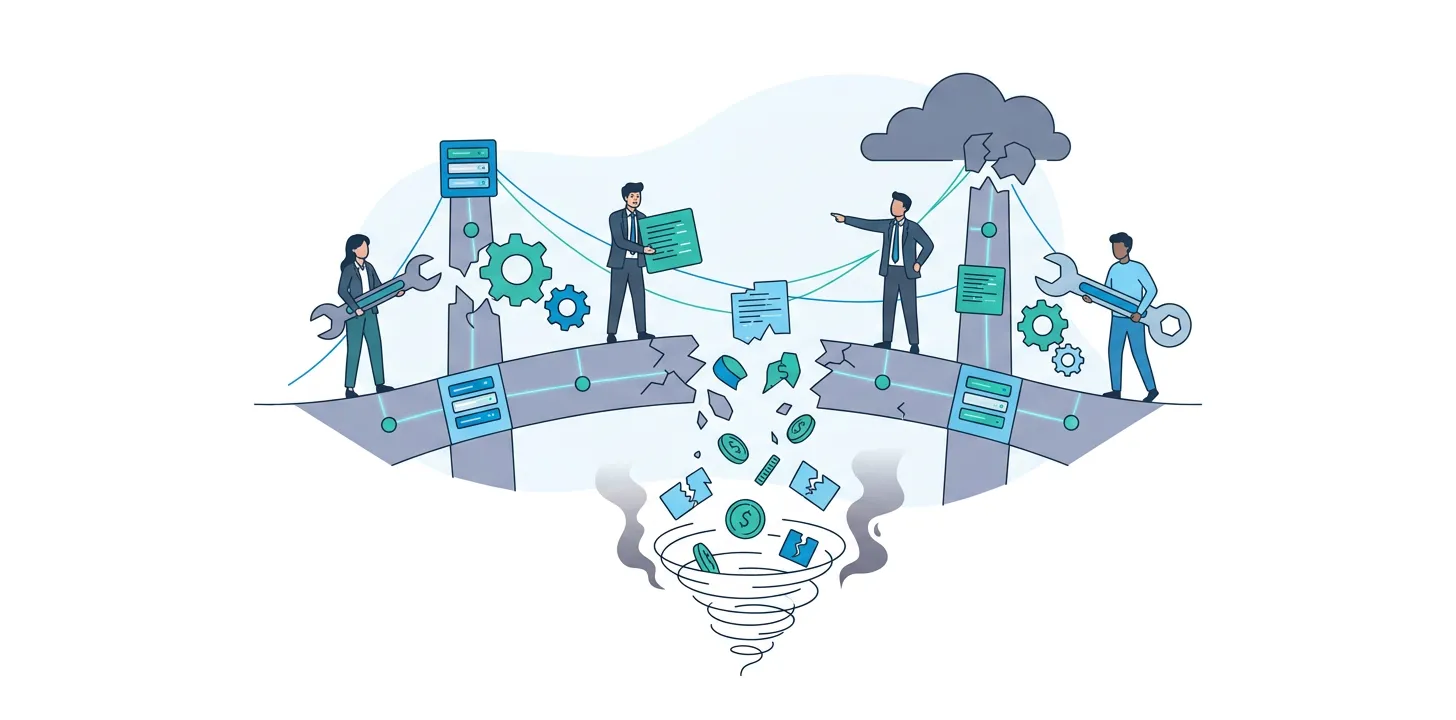
How iPaaS Creates Technical Debt Inside NetSuite + Salesforce
If you’ve ever tried to scale an organisation that runs Salesforce on one side and NetSuite on the other, you will know the feeling. It starts softly like a whisper, it could be a quiet mismatch in the numbers, a report that doesn’t match, a forecast that looks… wrong. No alarms, no red flashing lights. Just a tiny sense that something under the surface isn’t lining up.
This is how integration issues reveal themselves in growing companies: not with explosions, but with friction.
Most teams begin their integration journey with an iPaaS solution. It’s the expected route. It promises flexibility, “connect anything” logic, drag-and-drop automation, and the empowering fantasy that non-technical teams can keep complex systems talking to each other. And, early on, that flexibility feels like freedom.
But as your organisation grows: new products, new subsidiaries, new currencies, new billing models and soon you realise that same flexibility becomes something else. Something heavy. Something brittle. Something expensive.
This article explores the often-unseen cost of that flexibility: technical debt, hidden inside your NetSuite and Salesforce stack.
And once you see it, you can’t unsee it.
The myth of flexible integration
The pitch behind iPaaS is compelling: “Build whatever flow you want. Map whatever field you want. Write logic in a few clicks. You do not need engineers anymore.” And, at first, it works pretty much as advertised.
But business growth does not scale like a neat diagram. It expands like a branching tree, it is twisting, splitting, reacting to new markets, shifting compliance, global demand, and revenue models. And each time the business changes, the iPaaS layer must adapt.
A McKinsey ERP transformation report from 2025 captured this phenomenon:
“Big ERP transformations go off track not because technology is wrong, but because complexity grows faster than planned.”
iPaaS is built for flexibility. NetSuite is built for financial precision.
Those two worlds collide the moment your ERP and CRM need to operate as one.
Technical debt begins quietly
At first, you have a handful of flows:
- Opportunity to Order
- Order to Invoice
- Customer to Customer
- Payment to Payment
It feels neat, logical… almost elegant. But then the business evolves.
You add new regions. You expand subsidiaries. You bring in new billing models. You adjust approval processes. You introduce new product lines with distinct fulfilment rules.
And very quickly, your four flows become thirty. Then fifty. Then hundreds.
An integration partner described this transformation in ERP.Today’s 2024 coverage on the NetSuite ecosystem:
“Salesforce integration is fueling the NetSuite ecosystem, but businesses underestimate the underlying complexity until the data begins breaking at scale.”
The breaking isn’t loud. It is often subtle: a payment that doesn’t sync, an invoice missing a relationship, a credit memo created in the wrong subsidiary, an approval change that quietly invalidates a workflow.
These aren’t bugs. They’re symptoms of technical debt, the debt created by choosing flexibility over structure.
Where iPaaS technical debt actually comes from
1. Logic duplication is the silent killer
Businesses rarely have a single version of “the process.” They have variations:
- A rule for the UK entity
- A rule for the US
- A workaround for Canada
- A custom tax rule for Germany
- A currency nuance for APAC
In iPaaS, every variation becomes another branch.
Another flow. Another rule. Another point of failure.
Houseblend’s 2025 comparison of ERP innovation puts it succinctly:
“Companies think integration debt is the price of growth. It’s not. It’s the price of choosing the wrong architecture.”
2. Event-triggered workflows cannot guarantee financial lineage
An invoice isn’t just a record. It’s a chain of relationships:
- customer
- item
- tax
- revenue schedule
- payment
- credit memo
- currency
- subsidiary
iPaaS tries to recreate this lineage with workflows. But workflows don’t understand financial context — they only understand triggers.
You end up with a beautiful system that works… until it doesn’t.
3. Scaling doesn’t increase flows linearly, it multiplies them
iPaaS is deceptively calm at 5,000 records per month. At 50,000? At 500,000? At year-end audit season?
Everything becomes more fragile: retries, API concurrency limits, cascading flow failures, and data mismatches from sync windows.
Netgain’s 2025 integration guide puts it plainly:
“When data from NetSuite and Salesforce is synchronized, your team gains a clearer view of company-wide operations.”
But iPaaS doesn’t synchronise — it approximates. Native connections unify.
4. Error handling shifts from automation to human reconciliation
No one buys iPaaS thinking, “I want to manage an error queue for the rest of my life.” Yet this is the fate for many scaling enterprises.
Why?
Because once your flow library grows beyond a handful of rules, errors become both constant and ambiguous. You are no longer troubleshooting a problem, you are deciphering a puzzle.
5. Your most expensive resource becomes your “integration babysitter”
iPaaS begins as a low-code dream. It ends as a full-time job. Often for a senior admin who should be driving strategy, not patching JSON payloads at 7pm.
The business cost of flexible integration
When integration becomes a tangle of flows, the business suffers in subtle but expensive ways.
Forecasting breaks
Revenue in Salesforce stops matching revenue in NetSuite. Customer health signals become unreliable. Renewal predictions skew.
Financial governance collapses quietly
Auditors ask questions your architecture can’t answer.
“How was this invoice updated?” “What is the source of truth?” “Why does the payment not match the order?”
Teams lose trust in the data
Sales stops using reporting dashboards. Finance stops trusting CRM numbers. RevOps starts exporting CSVs again. Customer Success begins re-creating manual trackers.
Deloitte summarises the stakes beautifully in their 2025 NetSuite perspective:
“High-growth companies don’t scale by accident. They scale by embracing the systems, data models, and processes that keep growth sustainable.”
The implication is crystal clear: growth without structure isn’t growth, it’s chaos delayed.
The turning point: when flexibility becomes fragility
Every company hits a moment where leadership asks:
“Why does our integration need so much fixing?”
It’s the moment iPaaS reaches its architectural ceiling.
Because architectural problems don’t announce themselves. They show up in symptoms:
- data mismatches
- reconciliation fatigue
- a growing backlog of “temporary” flows
- month-end surprises
- customer billing issues
- inconsistent reporting
- approvals breaking workflows downstream
Systems fail not because data volume is too large, but because relational integrity cannot be guaranteed.
This is the moment you move from automation… to architecture.
Native integration: the opposite of technical debt
Native integration isn’t about flexibility. It’s about correctness. About maintaining the relationships inherent to financial data. About scaling without multiplying logic. About offering a foundation instead of a web of regressions waiting to happen.
Where iPaaS offers flows, native integration offers truth.
Where iPaaS offers events, native integration offers lineage.
Where iPaaS offers “connect anything”, native integration offers “connect what matters — properly”.
This is why enterprises eventually migrate.
Because they’re tired of repairing yesterday, and ready to build tomorrow.
A short diagnostic: are you accumulating technical debt?
Ask yourself five questions:
- Do you have more than 10 subsidiaries?
- Do your Salesforce and NetSuite numbers ever disagree?
- Do you maintain more than 30 flows?
- Does Finance ever reconcile CRM → ERP manually?
- Do small changes take weeks to implement?
If you answered “yes” to even one of these… your iPaaS architecture has already begun accumulating debt.
If you answered “yes” to three… you’re almost at the tipping point.
Conclusion: flexibility feels good today but truth scales tomorrow
iPaaS isn’t the villain. It’s simply the wrong long-term architecture for companies who rely on financial accuracy, multi-entity structure, and real-time operational truth. It’s brilliant at solving early problems and terrible at supporting mature ones.
The hidden cost of flexible integration isn’t the subscription. It’s the complexity it leaves behind.
And eventually, every enterprise outgrows complexity.
They move to an integration model that understands financial logic natively, supports global scale, and eliminates the fragile web of flows before it collapses.
That’s the path high-performing teams take: from flexibility to structure to clarity to scale.
And that’s where native NetSuite + Salesforce integration shines.
If your team is starting to feel the weight of integration maintenance, error queues, or reconciliation loops, you’re not alone. It’s a sign your business is outgrowing the architecture beneath it and that a new foundation is needed.Explore Breadwinner’s native NetSuite Salesforce integration [https://breadwinner.com/netsuite-salesforce-integration/)