
Why Enterprises Outgrow iPaaS for NetSuite Integrations
Scaling companies don't outgrow integration—they outgrow iPaaS. Learn why financial data needs stability, lineage, and accuracy that only native integration delivers.
Rohan Sharma
December 10, 2025
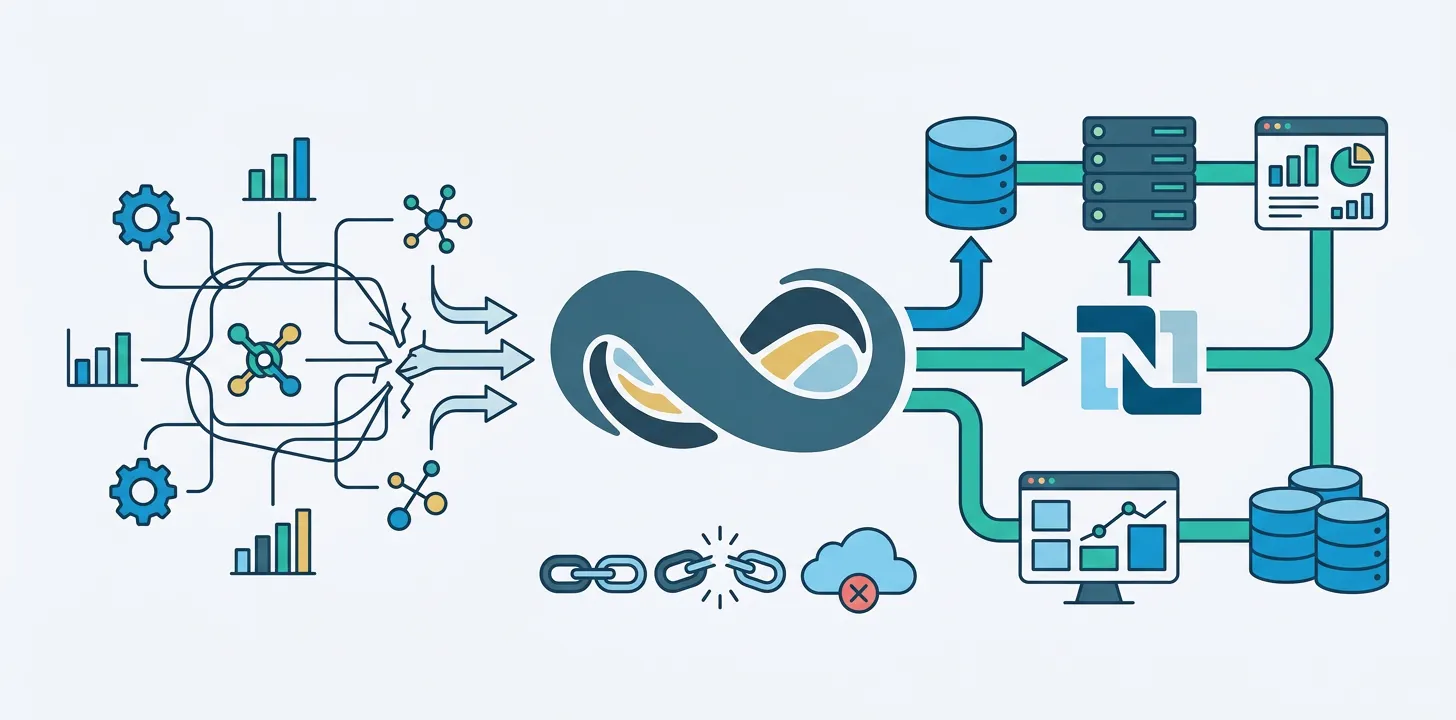
A Practical Guide for Scaling Companies
There’s a moment in every fast-growing organisation where the systems that once felt liberating start to feel strangely small. The CRM that gave sales superpowers suddenly can’t tell the full story. The ERP powering the financial engine begins to feel like a distant island. And the integration layer sitting between Salesforce and NetSuite (the place everyone assumed would “just work”) becomes the unexpected bottleneck.
Most companies don’t spot this moment early. iPaaS platforms often feel like the right answer in the beginning. They promise flexibility, fast wins, drag-and-drop flows, “connect anything to anything” messaging, and the reassurance that you don’t need developers to keep your business running. For a while, that promise holds true.
But there’s a pattern — and every consultant who has worked with enterprise Salesforce + NetSuite accounts has seen it. iPaaS doesn’t break suddenly. It breaks slowly… and then all at once.
A Salesforce-NetSuite integration guide published by Houseblend captured the essence perfectly:
“Disconnected systems are silent profit-killers. When Salesforce closes an order and NetSuite doesn’t know about it instantly, businesses end up with data silos, delays, and a fractured view of reality.”
And that’s the truth scaling companies eventually face: the more the business grows, the more the integration layer becomes the heartbeat of everything and the more it demands an architecture built for finance, accuracy, relationships, subsidiaries, approvals, and audit-ready truth.
iPaaS was never built for that world. Native integration was.
This is the story of why enterprises outgrow iPaaS.
The early illusion of “integration solved”
At the start, iPaaS feels magical. You map a few fields, build a handful of flows, and watch data move between Salesforce and NetSuite. It feels like building Lego with automation superpowers. But what looks simple on day one becomes slippery the moment the business starts adding:
- more products
- more territories
- more subsidiaries
- more currencies
- more approval rules
- more fulfilment models
- more customers, orders, invoices, payments, credit memos
Each new piece introduces its own rules. And each rule demands its own automation. iPaaS doesn’t understand financial lineage. It only understands triggers and workflows.
Codleo, a Salesforce consultancy, warns about this in their 2025 article on NetSuite–Salesforce integrations:
“While Salesforce and NetSuite work well on their own, not sharing information between them (and among the teams that use them) can create issues.”
What they’re really saying is: the gap grows faster than iPaaS can patch it. Every new flow is another moving part. Every mapping is a future point of failure. Every silent error is a future reconciliation nightmare.
When operational complexity meets financial reality
The real shock comes when enterprises realise that integrating NetSuite isn’t like integrating any other system. It is not about moving fields but it is about preserving financial correctness.
An opportunity is simple. An invoice is not. Contact is simple. A payment application is not. A custom object is simple. A credit memo tied to multi-currency rules, approval trees and revenue recognition logic… is absolutely not.
CFOs, controllers, and RevOps leaders understand the above because their world depends on sequence, lineage, timing, and accuracy (things that iPaaS doesn’t inherently protect).
And what happens when those financial relationships are not preserved correctly? As data complexity rises, systems struggle not because they cannot store data, but because they cannot maintain meaningful relationships across processes.
This is the line that quietly separates “moving data” from “maintaining truth.”
Scaling creates exponential integration fragility
If companies grew in straight lines, iPaaS might scale with them. But enterprise growth behaves more like a branching tree. Every new subsidiary, new region, new entity, or new billing model multiplies complexity.
McKinsey’s 2025 report on ERP transformations explains this elegantly:
“Big ERP transformations go off track not because technology is wrong, but because complexity grows faster than planned.”
When you add business growth to NetSuite’s intricate relational model, the iPaaS “flow library” becomes a labyrinth:
- one flow for orders
- another for invoices
- another for payments
- three variations for subsidiaries
- 10 variations for approval outcomes
- 20 branches for exceptions
- and dozens more for “temporary fixes” that somehow become permanent
Multi-subsidiary organisations hit the wall first
NetSuite OneWorld customers feel this pain earliest. Because each subsidiary is not just a new entity and it is a new ruleset:
- tax codes
- accounting calendars
- currencies
- GL structures
- workflows
- product catalogues
- legal requirements
An ERP consultancy wrote in 2025:
“Salesforce integration is fueling the NetSuite ecosystem… but organisations underestimate the complexity until the data starts breaking.”
iPaaS treats each edge case as another branch. Native integration treats it as part of the model.
That difference matters a lot.
The hidden costs of iPaaS: maintenance, reconciliation, and technical debt
iPaaS is sold as low-maintenance, and it is… for the first 90 days.
But beyond that? Enterprises start paying for:
1. Flow maintenance
Every business change means editing a dozen flow steps.
2. Data reconciliation
Finance teams lose hours chasing discrepancies.
3. Errors that hide
The worst thing about iPaaS is not just when it breaks loudly but it is when it breaks quietly.
4. Latency
Sync windows introduce timing mismatches that cause:
- incorrect forecasts
- wrong renewal signals
- customer success misclassifications
- double billing
- payment mismatches
5. Specialist headcount
You need a full-time automation admin just to keep the lights on.
A 2025 ERP comparison by Houseblend summarised it bluntly:
“Companies think integration debt is the price of growth. It’s not. It’s the price of choosing the wrong architecture.”
Why native integration becomes the only long-term solution
Native integration does not only copy NetSuite logic but it understands it.
A native, financial-grade connector:
- respects NetSuite object lineage
- preserves customer to order, to invoice, to payment and to credit memo relationships
- handles multi-subsidiary logic without dozens of flows
- syncs financial truth in near-real-time
- eliminates the “silent failures” that haunt iPaaS
- gives Salesforce users a complete, trustworthy picture of revenue, risk and customer health
Consultancy Netgain wrote in April 2025:
“When data from NetSuite and Salesforce is synchronized, your team gains a clearer view of company-wide operations.”
The irony: enterprises think they need automation flexibility. What they actually need is financial stability.
What scaling companies need to ask before choosing an integration model
Here are the real questions leaders should be asking:
**Will this integration support my next 10 subsidiaries without rebuilding everything?**If the answer is no, iPaaS isn’t the right tool.
**Can Finance rely on the data without cross-checking every day?**If the answer is no, you don’t have an integration, you have a liability.
**Does the system preserve every financial relationship NetSuite cares about?**If not, you’re exposed to reconciliation errors.
**Will my integration break silently when NetSuite custom fields change?**If yes, that’s a governance risk.
**Does our integration grow with us, or does it get more fragile as we scale?**iPaaS gets heavier. Native integration gets stronger.
Are we fixing yesterday or building for tomorrow?
Conclusion: choosing iPaaS is not wrong. It’s just the wrong tool for financial truth.
As companies grow, the integration layer becomes a make-or-break factor. iPaaS delivers great early wins, but its architecture is built for flexibility and not financial fidelity. NetSuite’s world is different. It demands stability, consistency, reliability, and multi-entity intelligence.
Enterprises don’t outgrow iPaaS because it’s bad technology. They outgrow it because they outgrow the assumption that automation is enough.
In truth, enterprises need something sturdier:
Financial-grade. Native by design. Unbreakable at scale.
A system that doesn’t fight complexity but embraces it.
If your team is starting to say things like “why doesn’t Salesforce match NetSuite?” or “why are we fixing the integration again?”, that’s your sign.
It’s time to move from automation… to architecture.Explore Breadwinner’s native NetSuite Salesforce integration [https://breadwinner.com/netsuite-salesforce-integration/)