
Why iPaaS Struggles When You Try to Integrate NetSuite and Salesforce at Scale
As financial complexity scales, iPaaS silently breaks. Discover why only native integration can preserve the structure, accuracy, and trust that NetSuite financial data requires.
Rohan Sharma
December 3, 2025
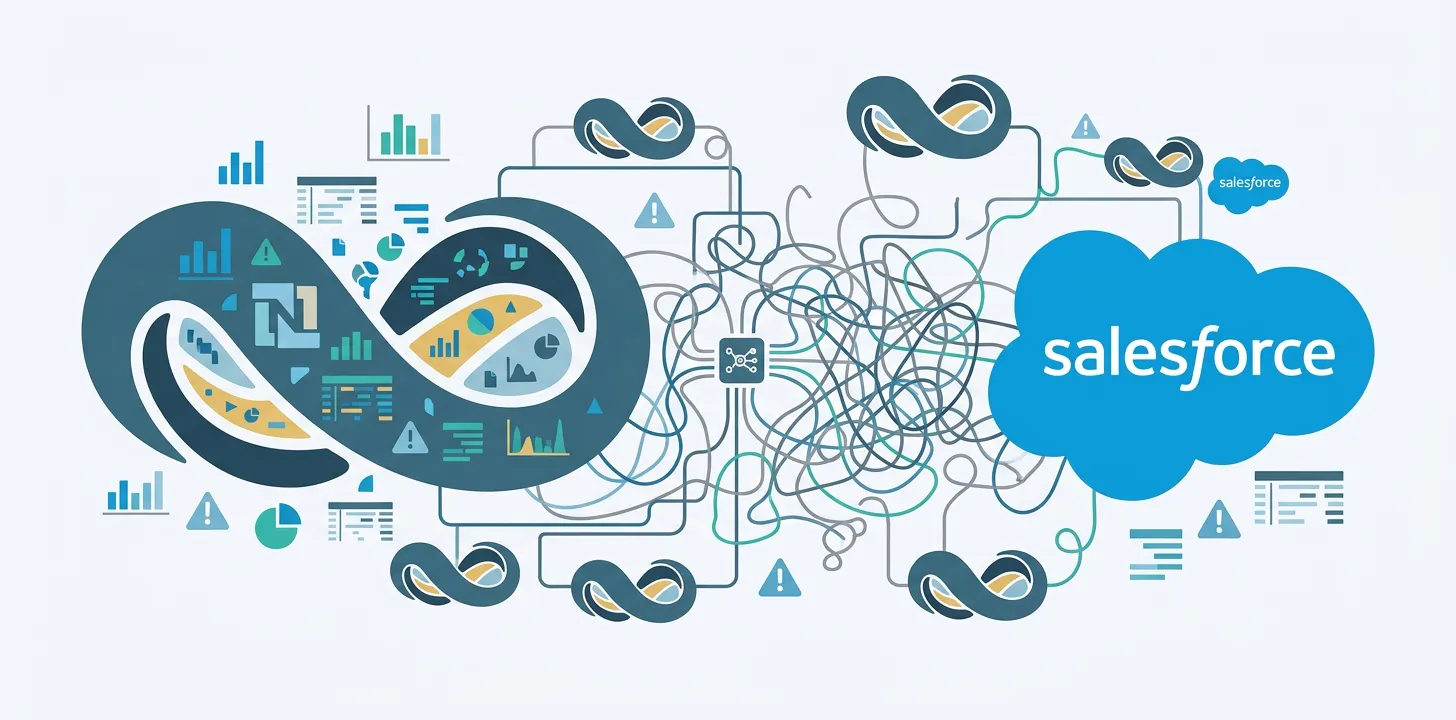
In today’s complex enterprise landscapes, when Salesforce runs the engine of customer operations and NetSuite manages the financial backbone, the integration between these platforms becomes critical. These companies operate across multiple geographies, manage layered revenue streams, and depend on financial clarity to steer strategic decisions. At this point, integration is no longer a simple data sync; it becomes the trustworthy nervous system of the business.
However, many enterprises initially turn to integration platform as a service (iPaaS) solutions such as Workato, Celigo, MuleSoft, or Boomi,enticed by promises of agility, reusable automation, and rapid deployment. While suitable for lightweight operational use cases in marketing or HR, iPaaS quietly begins to show critical limitations as the scale and complexity of NetSuite financial data integration grows.
The Hidden Costs of Silent Failures
Salesforce research warns 70% of organizations do not provide completely connected user experiences. It is logical to think that one of the reasons would be due to silent workflow failures or schema changes that no monitoring system catches. Such silent degradation infiltrates sales forecasts, customer health analytics, finance reconciliations, and leadership dashboards, eroding confidence in data-driven decision making.
Scaling automation introduces complexity that does not grow linearly, but exponentially. As businesses add subsidiaries, currencies, revenue recognition rules, and approval workflows, each additional integration flow introduces fragile dependencies capable of cascading failure.
Financial data demands unparalleled accuracy and tolerance levels; even minor mapping or data lineage errors can trigger systemic disruptions, this is a fundamental mismatch with how iPaaS platforms operate.
SaaS Innovator Case
Nauto’s rapid global growth experienced the limits of Boomi-based integration early. Initially handling sales orders and account syncs at modest volume, the implementation began to buckle under the weight of multi-entity financials and intricate revenue recognition rules. Manual intervention became daily. Leadership identified a critical need for a native architecture that aligned tightly with NetSuite’s financial model to reduce operational risk.
Why NetSuite Financial Objects Challenge iPaaS Design
NetSuite’s financial objects (like invoices, journal entries, credit memos, payments) are far from simple data points. A single invoice might touch customers, sales orders, tax codes, subsidiaries, revenue schedules, and multiple currencies simultaneously. Such objects are heavily validated through complex rules embedded in the ERP.
Financial records require lineage, referential integrity, and auditability, which drag-and-drop iPaaS platforms cannot ensure at scale. This structural integrity is a technical impossibility for iPaaS frameworks designed around modular, loosely coupled event-driven tasks rather than enterprise financial orchestration.
Professional Services Example
A multi-subsidiary professional services firm used Celigo to link Salesforce CPQ and NetSuite. Each subsidiary had its own tax rules, approval workflows, and charts of accounts which are forcing proliferation of flows and custom scripts. Though operational automation improved, maintenance costs grew, and silent breakages during close were common, forcing long reconciliation cycles.
The Exponential Scalability Problem
While initial iPaaS deployments might elegantly connect 10 or so flows, enterprise growth quickly overwhelms the architecture. Complexity scales exponentially, not linearly. The result? What started as manageable automations balloon into dozens or hundreds of flows, many poorly documented and prone to failure with system updates.
Each additional subsidiary, currency, or custom object becomes another node of manual maintenance, difficult to debug and fragile to upstream changes. The integration layer becomes a chronic operational bottleneck.
The Multi-Subsidiary Challenge with NetSuite OneWorld
NetSuite OneWorld’s power is in managing global complexity, subsidiaries often differ in legal frameworks, tax treatments, currencies, P&L structures, item catalogs, and approval chains. iPaaS solutions don’t natively interpret these complexities; instead, they require bespoke logic for each variation.
The result is duplicated flows that grow uncontrollably with organizational expansion, multiplying maintenance overhead and integration risk.
Breadwinner’s native architecture respects OneWorld’s inherent structure. It can handle subsidiaries as configured in NetSuite directly, eliminating redundant flows and drastically reducing operational overhead.
The Inevitable Fragility of iPaaS When Handling Financial Data
The biggest challenge with iPaaS isn’t that it breaks loudly. The problem is that it breaks quietly.
When a NetSuite field changes (maybe Finance adds a classification field or adjusts a custom segment) the integration layer doesn’t always know how to handle it. If a workflow changes, an approval process is updated, or a subsidiary gets added, the flows that looked perfectly stable yesterday may start dropping data today.
No alerts. No obvious errors. Just missing or incomplete financial information.
In fact, Deloitte warns that “silent data quality degradation” is one of the biggest sources of operational risk for enterprise systems.
When financial data goes missing:
- sales teams make incorrect forecasts
- customer success teams misread account health
- finance teams spot reconciliation mismatches during close
- executives lose confidence in dashboards and reports
The integration layer doesn’t just impact systems, it impacts how people across the company make decisions.
Why NetSuite Financial Objects Push iPaaS Beyond Its Intended Purpose
A contact record is simple. A lead is simple. Even a custom object can be simple. But a NetSuite invoice is not simple. A NetSuite payment is not simple. Neither is a credit memo, a journal entry, or an item fulfillment.
These objects are deeply relational, tightly validated, and interconnected across multiple layers of the system.
A single invoice typically relates to: a customer, a sales order, an item record, a tax code, a subsidiary, a location, fulfilment data, multi-currency calculations, revenue rules, payment records, credit memos and outstanding balances.
iPaaS simply wasn’t built for this level of financial orchestration. Financial records require lineage, referential integrity, and structural consistency, things drag-and-drop workflows cannot guarantee.
This is why iPaaS often works perfectly for lightweight operational automation but not for enterprise financial syncing.
The moment financial truth is involved, architecture matters.
Scaling Makes the Problem Worse
At small volumes, iPaaS looks powerful. A few flows, a handful of mappings, one or two subsidiaries, everything feels manageable.
But enterprise growth adds pressure in every direction: more transactions, more subsidiaries, more currencies, more approvals, more workflows, more revenue rules, more custom segments, more custom objects, more data velocity and more reporting requirements
Complexity doesn’t grow linearly, it grows exponentially.
This is exactly why companies outgrow iPaaS during the scaling stage.
What starts as: “We have 10 flows.” Becomes: “We have 47 flows… and nobody knows how half of them work anymore.” The business grows faster than the integration layer can handle. And suddenly integration is no longer a capability and it’s a vulnerability.
The Multi-Subsidiary Breaking Point
NetSuite’s OneWorld architecture is powerful but complex. Subsidiaries differ in: chart of accounts, tax structures, approval trees, currencies, workflows, legal requirements and item catalogues.
iPaaS doesn’t inherently understand these differences. It forces you to build logic for each one.
Which is why global organisations often see their flow counts multiply as they expand. Each new region or entity becomes another layer of maintenance.
Breadwinner doesn’t require duplication, it reads and respects NetSuite’s structure as it is.
This is the moment most enterprises realise that they don’t need a more powerful iPaaS, they need a more intelligent integration architecture.
The Most Dangerous Problem: Undetected Failures
This is the most expensive type of integration failure because it corrupts trust. People assume their dashboards are correct. They assume the numbers are fresh. They assume the system is behaving.
By the time the issue surfaces, the impact has already spread across: forecasting, renewals, credit risk, revenue reporting, commissions, customer communication and financial close
Data issues that propagate downstream because the integration layer doesn’t enforce financial discipline.
iPaaS is built for automation. Financial data is built for accuracy. These two goals conflict.
Why Native Integration Becomes the Only Sustainable Path
This is where architecture matters.
Breadwinner takes a completely different approach. Instead of orchestrating dozens of flows, transformations, and API calls, it brings NetSuite financial data directly into Salesforce in a native structure that preserves:
- financial relationships
- validation rules
- record lineage
- subsidiary logic
- multi-currency integrity
- auditability
No flows. No breakpoints. No sync windows. No fragile transformation logic. No hidden failures.
Salesforce users finally see NetSuite exactly as it exists: clean, accurate, and complete.
For teams that rely on this data, the impact is transformative:
- Finance gets fewer reconciliation issues
- Sales gets real-time information
- RevOps gets accurate forecasts
- Customer Success sees customer health instantly
- Support understands payment status
- Executives make decisions using one version of truth
The integration layer stops being a liability and becomes a strategic asset.
The Modern Reality: iPaaS Was Never Designed for Financial Precision
iPaaS is extraordinary for what it’s built for: workflow automation, cross-department logic, event-driven tasks, and operational coordination.
But none of those requirements match what NetSuite financial data needs. Financial data demands:
- stability
- lineage
- structural integrity
- predictable performance
- audit readiness
- relationship preservation
When Salesforce and NetSuite power your business, the integration layer cannot be a “nice to have.” It becomes the bloodstream of the organisation, and bloodstream systems demand robustness, not just flexibility.
Conclusion
iPaaS platforms shine in cross-functional automation but falter when faced with enterprise-grade financial data complexities at scale. The time comes when the integration layer must evolve past flexibility into resilience, stability, and auditability.
For organizations leveraging NetSuite and Salesforce at scale, native integration architectures like Breadwinner’s are the only sustainable way to secure accurate financial data, reduce operational risk, and empower data-driven decisions across sales, finance, and executive stakeholders.
The integration layer transforms from a costly liability into a strategic business enabler, speeding financial close, sharpening forecasting, and fostering unwavering trust in data.