
Why Santa Would Never Run Finance on Spreadsheets
A festive take on why spreadsheets fail at scale for finance teams, and why structured, real-time financial data in Salesforce beats manual reconciliation every time.
Rohan Sharma
December 24, 2025
The Impossible Maths of Christmas
Every year, Santa is expected to visit 91.8 million homes in 31 hours, giving him roughly .001 seconds per household.
To do this, he’d need to:
- Travel 75.5 million miles
- At 650 miles per second
- Roughly 3,000× the speed of sound
At that velocity:
- The lead reindeer would absorb 14.3 quintillion joules of energy per second
- The entire sleigh team would be vaporised in 0.00426 seconds
- Santa himself would experience 17,500× the force of gravity
Conclusion: If Santa operated in the real world, Christmas wouldn’t happen.
Which is fine. Christmas runs on magic.
Finance does not.
Why Santa Would Never Use Spreadsheets
Now imagine Santa’s back office.
- Millions of line items.
- Last-minute changes.
- Multiple regions.
- Zero margin for error.
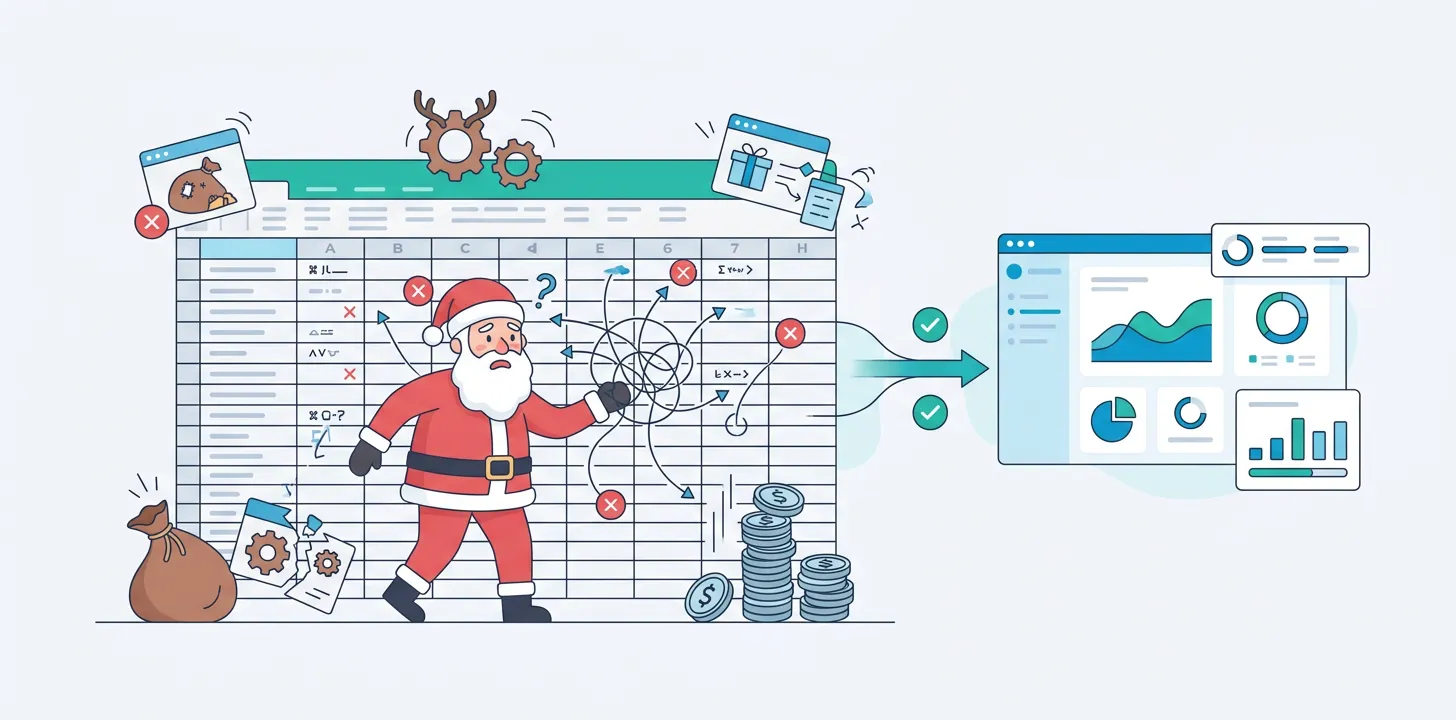
If Santa managed this with spreadsheets:
- Data would need to be exported
- Formulas would break silently
- Versions would multiply (Final_Final_Christmas_v67.xlsx)
- Errors wouldn’t appear immediately… just later, when it’s too late
Spreadsheets don’t fail dramatically. They fail quietly.
At scale, quiet failures are the most dangerous kind.
Christmas Trees and Revenue Systems Need Structure
(Search intent: systems architecture, data integrity)
A Christmas tree looks simple—until you build one.
- Structure first.
- Branches second.
- Lights third.
- Decorations last.
Skip the structure and you don’t get Christmas. You get tangled lights and frustration.
Revenue systems are the same:
- Invoices are the branches
- Payments are the lights
- Credits and adjustments are the decorations
Without structure:
- Finance spends time untangling instead of analysing
- Sales waits for answers
- Leadership questions the numbers—again
The Silent Failure of “It Syncs”
Modern finance doesn’t usually break.
It drifts.
Assume:
- Salesforce updates in real time
- Finance systems update later
- An integration syncs every 15 minutes (96 times a day)
Now add:
- Backdated invoices
- Partial payments
- Contract amendments
- Revenue recognition rules
Nothing explodes. Numbers just slowly diverge.
By month-end:
- Sales sees one truth
- Finance sees another
- Leadership asks everyone to “align”
That’s not alignment. That’s structural failure.
Santa Has .001 Seconds per House and Sales Has Zero Patience
Santa doesn’t have time to:
- Ask another elf
- Recheck a report
- Wait for a sync to finish
Neither does Sales.
Every time Sales asks Finance:
- “Has this invoice been paid?”
- “Can we renew?”
- “Why does this number look different?”
That’s the sleigh stopping mid-air.
Multiply that across a team and Finance becomes a help desk instead of a strategic function.
Why Breadwinner Exists
Breadwinner doesn’t rely on magic.
It keeps financial data:
- Native
- Structured
- Real-time
- Inside Salesforce
Invoices, payments, credits, and status stay aligned without:
- Manual exports
- Silent sync failures
- Spreadsheet archaeology
Santa wouldn’t reconcile after Christmas.
He’d wire the sleigh once and trust it.
The Real Lesson of Christmas for Finance Teams
Christmas works because:
- Structure comes first
- Magic comes second
Finance works the same way.
When systems are designed properly:
- Sales stops guessing
- Finance stops firefighting
- Leaders stop questioning the numbers after meetings
The best gift Finance can receive isn’t another dashboard.It’s numbers that don’t move.
FAQ Section
Is it possible to manage revenue accurately with spreadsheets?
Spreadsheets work at small scale, but they don’t preserve structure or context as complexity grows. At scale, they introduce silent errors, version conflicts, and reconciliation delays that undermine trust in financial data.
Why do finance systems drift out of sync with Salesforce?
Most integrations update on intervals and lack native understanding of financial structures like partial payments, credits, and backdated changes. Over time, small delays compound into material discrepancies.
Why is real-time financial data important for sales teams?
Sales teams need accurate invoice and payment status to answer customer questions, manage renewals, and close deals. Delayed or conflicting data slows revenue and damages credibility.
What makes Breadwinner different from iPaaS solutions?
Breadwinner is native to Salesforce and preserves financial structure instead of flattening it. This prevents data drift and keeps sales and finance aligned in real time.
What is the biggest risk of manual revenue processes?
The biggest risk isn’t immediate failure—it’s gradual loss of trust. When numbers change after meetings, teams stop believing the data, and decisions suffer.