






Does QuickBooks Integrate with Salesforce? (Yes, and How to Choose)
Yes, QuickBooks Online integrates with Salesforce. Three routes compared: native AppExchange app, iPaaS, and custom API build, plus how to choose.
Breadwinner Team
September 10, 2026
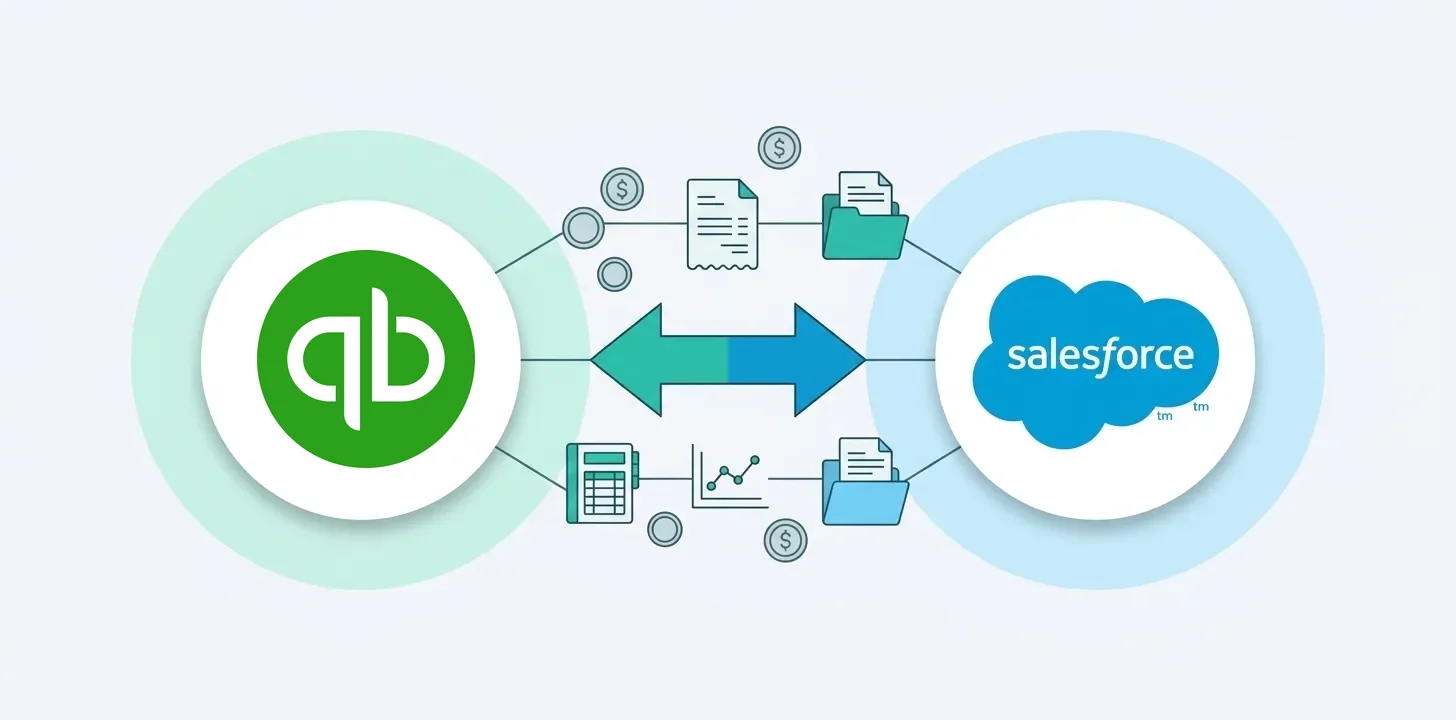
Yes, QuickBooks Online integrates with Salesforce. There are three routes: a native Salesforce AppExchange app (fastest to deploy, no middleware), a general-purpose iPaaS platform such as Zapier, Celigo, or Workato, or a custom API build. Unlike NetSuite, where Oracle publishes its own Salesforce connector, Intuit doesn’t ship a first-party QuickBooks and Salesforce integration, so the choice comes down to those three. The right one depends on your setup timeline, who owns ongoing maintenance, and whether your finance data needs to stay inside your Salesforce security boundary.
The rest of this guide explains what each route actually looks like, what it costs in time and effort, and how to pick. If you’ve already chosen the native-app route and just want the setup steps, jump straight to how to integrate QuickBooks with Salesforce.
The 3 ways to integrate QuickBooks with Salesforce
At a high level:
- Native Salesforce AppExchange app (e.g. Breadwinner). Installs inside your Salesforce org, with no middleware and real-time two-way sync out of the box.
- General-purpose iPaaS platform such as Zapier, Celigo, or Workato. Broad app support, but you configure and maintain the finance-specific workflows yourself.
- Custom API integration that you build against the QuickBooks Online API with Apex callouts on the Salesforce side. Maximum flexibility, but a permanent maintenance load.
Each is a legitimate choice for different teams. The differences show up in three places: how long setup takes, who owns ongoing maintenance, and how cleanly the tool handles finance edge cases like partial payments, credit memos, multi-currency, and custom fields.
1. Native Salesforce AppExchange app (fastest, most Salesforce-native)
A native app is a managed package installed directly from the Salesforce AppExchange into your Salesforce org. QuickBooks records such as customers, invoices, payments, and credit memos sync into Salesforce and appear on the account records your reps already use. There’s no external integration cloud sitting between the two systems.
Breadwinner’s native QuickBooks Salesforce integration is one example: it installs in hours, ships with pre-configured field mappings, and syncs both ways in real time. Because the sync logic runs inside your Salesforce security boundary, you inherit Salesforce’s permission sets, profiles, and sharing rules rather than managing a separate access layer.
Best for: teams that want QuickBooks data visible in Salesforce this week, without a development project, and prefer vendor-owned maintenance.
2. General-purpose iPaaS platform (Zapier, Celigo, Workato)
An iPaaS is a general-purpose integration platform. You configure “zaps,” recipes, or workflows that move data between QuickBooks, Salesforce, and any other apps in your stack.
The strengths are breadth (many app connectors on one platform) and flexibility (you can model almost any workflow). The trade-off is that you own the accuracy and maintenance of every workflow. Finance is full of edge cases like partial payments, credit memos, refunds, and multi-currency, and a workflow that silently drops one of them creates the exact data-quality gap you were trying to close. Many iPaaS templates are also one-directional by default until you extend them.
Best for: engineering-minded teams that already run an iPaaS platform for cross-app automation and are willing to build and maintain finance-specific workflows.
If you are deliberately trying to avoid this layer, we cover the alternative in how to sync QuickBooks and Salesforce without Zapier or middleware.
3. Custom API integration
QuickBooks Online exposes a REST API. A custom integration means building against it from Apex callouts on the Salesforce side, storing synced data in your own custom objects, and running the sync loop on a schedule or via triggers. (If this is the route you’re weighing, our API vs native app breakdown for QuickBooks goes deeper on the trade-off.)
The upside is maximum flexibility: you can model anything. The downside is that you own everything: OAuth setup, token refresh, retry logic, rate-limit handling, error alerting, sync scheduling, a field-mapping UI for admins, and ongoing maintenance for every QuickBooks API change. That’s typically weeks to months of initial engineering plus a permanent maintenance load.
Best for: engineering-led teams with unusual requirements that off-the-shelf tools genuinely can’t satisfy, and the appetite to own the integration long-term.
How to choose the right approach
Answer these four questions honestly and the right route usually becomes obvious:
- Do you have Salesforce developers on staff long-term? If no, a native AppExchange app. If yes, any option is on the table.
- How fast do you need first value? Hours (native app), weeks (iPaaS), or weeks to months (custom build).
- Who should own maintenance? The vendor (native app) or your team (iPaaS and custom builds, where every workflow and API change is yours).
- Do you want the finance data inside your Salesforce security boundary? Native apps run inside your org. iPaaS platforms and custom builds route data through external infrastructure, which is a separate attack surface to review.
For most SMB and mid-market teams that run Salesforce for sales and QuickBooks Online for finance, the native AppExchange app answers all four in the direction of least effort. Teams with an existing iPaaS investment sometimes go that route; custom builds are the right call in a narrow set of cases.
Once you’ve picked, the setup itself is quick. Here’s the step-by-step guide to integrating QuickBooks with Salesforce.
Frequently asked questions
Does Salesforce have a native QuickBooks integration?
Salesforce doesn’t publish its own QuickBooks integration, and neither does Intuit. The Salesforce AppExchange hosts native apps (like Breadwinner) that install directly into your Salesforce org and behave as if they were part of Salesforce itself, which is the closest thing to a native QuickBooks Salesforce integration.
Is a QuickBooks Salesforce integration two-way?
It depends on the tool. Native AppExchange apps like Breadwinner support real-time two-way sync out of the box. Create an invoice from a Salesforce opportunity and it appears in QuickBooks; when it’s paid in QuickBooks, the status updates in Salesforce. iPaaS workflows and custom builds are only as bi-directional as you configure them to be.
Does the integration work with QuickBooks Desktop?
Native cloud apps connect to QuickBooks Online, not QuickBooks Desktop. Connecting Desktop to Salesforce generally requires middleware or a custom connector, or migrating to QuickBooks Online first.
Do I need middleware like Zapier to connect QuickBooks and Salesforce?
No. Middleware (iPaaS) is one of the three routes, but a native Salesforce app removes the need for it. There’s no separate platform to run, pay for, or maintain, and your finance data doesn’t pass through a third-party cloud.
Ready to see a native QuickBooks Salesforce integration in action? Book a Breadwinner demo. It’s 30 minutes in a Salesforce sandbox wired to QuickBooks Online, with your hardest finance workflow on the agenda.