






How to Connect QuickBooks to Agentforce
Connecting Agentforce or Claudeforce to QuickBooks is easy to start and full of headaches to run. See the DIY flow, the permission limits, and the easier native way with Breadwinner.
Breadwinner Team
October 7, 2026
Technically reviewed by the Breadwinner engineering team
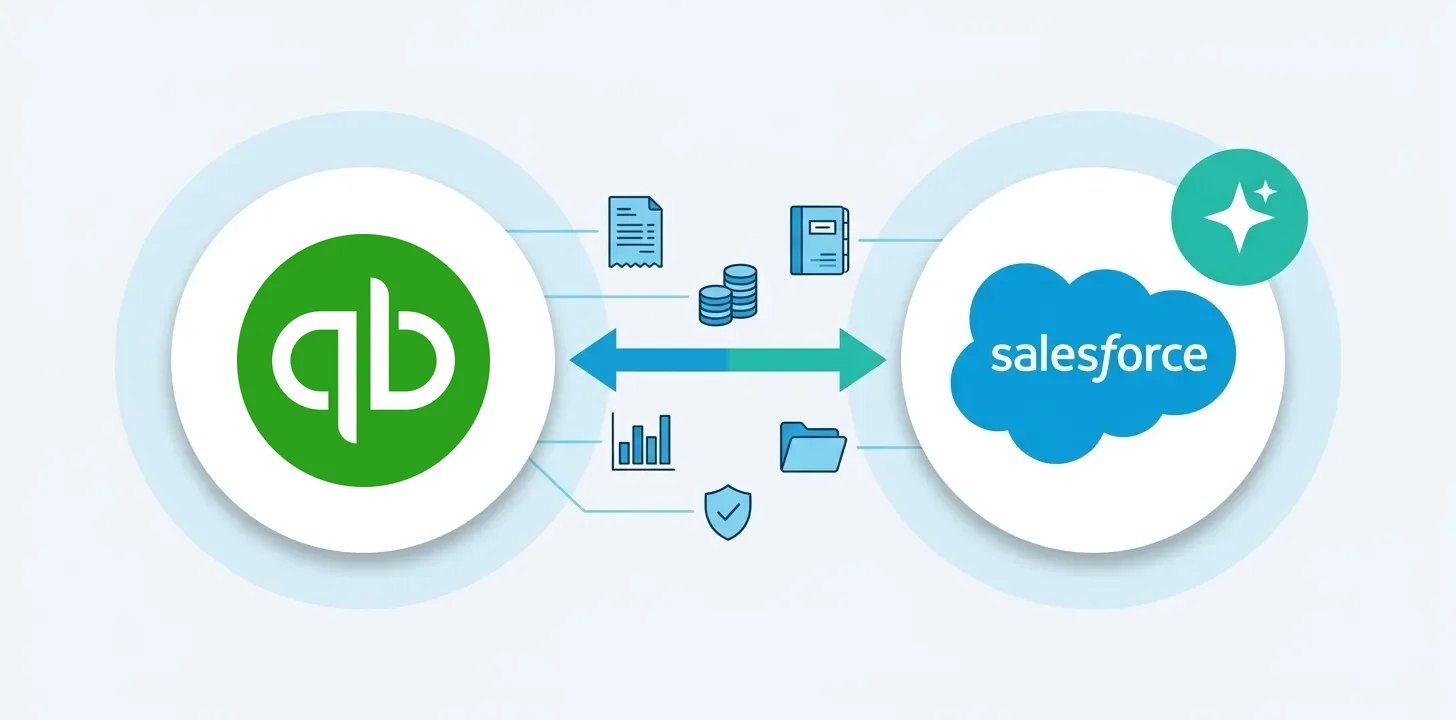
You can connect QuickBooks to Agentforce, and there are two ways to do it: wire Agentforce directly to the QuickBooks API yourself, or bring QuickBooks data into Salesforce as native records first and let Agentforce read it there. The same choice applies to Claudeforce, the Claude-powered version of Salesforce’s agents. The direct route is easy to start and full of headaches to run: it hands an AI agent unguarded access to your books, gives you no reporting or controls, and pushes you toward building a data warehouse to do it safely. The native route is the one finance and IT teams can actually sign off on, and it is easier. Here is how each works, and where the direct route breaks.
Can Agentforce connect to QuickBooks?
Yes. Agentforce agents can answer questions and take actions using QuickBooks data, but only if that data is reachable from Salesforce. Agentforce reasons over what lives in your Salesforce org and the actions you expose to it. QuickBooks data does not live in Salesforce by default, so something has to put it there, or fetch it on demand. That choice, fetch-on-demand versus native records, is the whole decision.
Option 1: Connect Agentforce directly to the QuickBooks API (the DIY route)
Starting is deceptively easy, and that is the trap. The do-it-yourself path is to build a custom Agentforce action that calls the QuickBooks Online API, and point your agent at it. In practice that is:
- Register an Intuit developer app and complete the QuickBooks OAuth flow, including the refresh-token handling that keeps the connection alive.
- In Salesforce, create an External Credential and a Named Credential to hold the QuickBooks authentication and endpoint.
- Import the QuickBooks API as an External Service from its OpenAPI schema, or write Apex that calls it through the Named Credential.
- Build the Agentforce action, define its inputs and outputs, add it to the agent’s topic, write the instructions, and test it.
- Then own it: token refresh, API rate limits, pagination, error handling, and a fix every time the QuickBooks API changes.
For a single read-only lookup in a demo, this works, which is exactly why it looks tempting. The headaches start the moment you move past the demo.
A point worth being clear on: Agentforce cannot do any of this out of the box. Its standard actions cover summarizing records, drafting emails, and finding or aggregating Salesforce data. Creating an invoice, reading a balance, or syncing a payment are not standard actions, they are custom actions you build and maintain in Apex, Flow, or a prompt template (per Salesforce’s own Agentforce actions guidance). So “connect QuickBooks to Agentforce” always means “build and own the connection,” unless you use a package that ships it.
Here is what even a simple “create an invoice” custom action looks like, so the maintenance load is concrete:
// Illustrative: a custom Agentforce action that creates a QuickBooks invoice.
// Agentforce has no standard finance action, so you build and own this.
public with sharing class CreateQuickBooksInvoice {
    @InvocableMethod(label='Create QuickBooks Invoice')
    public static void create(List<Request> requests) {
        for (Request r : requests) {
            HttpRequest req = new HttpRequest();
            // A Named Credential holds the OAuth token and base URL.
            req.setEndpoint('callout:QuickBooks/v3/company/' + r.realmId + '/invoice');
            req.setMethod('POST');
            req.setHeader('Content-Type', 'application/json');
            req.setBody(JSON.serialize(new Map<String, Object>{
                'CustomerRef' => new Map<String, Object>{ 'value' => r.customerId },
                'Line' => r.lineItems
            }));
            HttpResponse res = new Http().send(req);
            // You also own: token refresh, 401 and 429 handling, retries,
            // pagination on reads, and a fix every time the API changes.
        }
    }
    // plus Request and Response wrapper classes, test coverage, and error handling
}
That is one action, for one task, on one system. A real deployment needs this for reads, writes, multiple record types, and every finance system you run.
Where the DIY route breaks
Permissions: QuickBooks has no read-only scope
This is the catch. The QuickBooks Online API has one accounting permission scope, com.intuit.quickbooks.accounting, and it grants read and write access to the entire accounting API. There is no read-only option, and no endpoint-level or record-level control (Intuit’s own developer scopes documentation lists the single accounting scope). So the moment you connect an agent to QuickBooks directly, it can read everything and change everything, with nothing in between. This is why Breadwinner replicates QuickBooks into Salesforce as read-only records instead: it is the control QuickBooks itself does not give you. (Xero is a little better, it offers read-only scopes, but they are org-wide and do not map to your Salesforce record permissions, which we cover in the Xero guide.)
Security: the agent gets unguarded access to sensitive finance data
Because the QuickBooks scope is all-or-nothing, the agent, and anyone who can prompt it, can reach sensitive financial information: account balances, bank and transaction details, vendor and bill payments, profit and loss, and every customer’s full invoice and payment history. There is no record-level Salesforce permission model in front of it, because the data never entered Salesforce. You are trusting a prompt, not your existing access controls.
Control: nothing stops an agent from acting on your books
Reading is only half the risk. If the DIY action is allowed to write, an agent can create a credit memo, edit an invoice, or post into a closed period, with no approval step and no guardrail. For a finance team, uncontrolled write access to the general ledger is not a convenience, it is an audit and fraud exposure. A direct connection has no concept of “the agent may read this but may never do that.”
Reporting and integration: the data is not really in Salesforce
Because a fetch-on-demand call returns a temporary answer rather than a stored record, the QuickBooks data never becomes a native Salesforce object. That has consequences well beyond the agent: you cannot build Salesforce reports or dashboards on it, you cannot roll it up to the account, it does not appear on page layouts, and other tools and automations in your org cannot use it. You also lose multi-entity handling and reliable account lookups, because there is no modeled relationship between a QuickBooks customer and a Salesforce account. You get an answer in the chat and nothing you can operate on afterward.
Infrastructure: doing this safely yourself means building a data warehouse
Here is the deeper problem, and it is the one most teams miss until they are in it. QuickBooks and Xero have weak read-only permission controls, so you cannot simply hand an agent a safe, read-only view of the finance system itself. To do it properly, the do-it-yourself route is to replicate the finance data into a data warehouse you stand up, govern, secure, and keep synced. That is a real infrastructure project with ongoing cost and maintenance, not a weekend integration. Most teams will not, and should not, build and run a data warehouse just so an agent can read an invoice safely.
Completeness: one API call is a partial answer
A single API call returns a paginated, rate-limited slice. It cannot aggregate or filter across records, so questions like “total overdue across all entities in the last 90 days” are out of reach. The agent answers confidently from partial data, which is worse than not answering.
Option 2: Bring QuickBooks into Salesforce natively, then let Agentforce read it
The route finance and IT can approve is to replicate QuickBooks data into Salesforce as native, read-only records first, and point Agentforce at that. This is what Breadwinner does, and it is the same reasoning behind choosing a native app over an API connection in the first place (see API vs native apps for QuickBooks and the financial data problem iPaaS cannot solve). Breadwinner for QuickBooks is the Salesforce-native integration for finance teams: a native Salesforce managed package, installed from the AppExchange, SOC 2 Type II audited, a Salesforce partner since 2014, and rated 4.99 stars across 100+ AppExchange reviews. It syncs invoices, payments, customers, and credit memos into Salesforce as objects, and most teams are live in hours.
With the data native:
- Security is your existing Salesforce model. Agents read QuickBooks records under the same permissions, profiles, and sharing rules you already enforce. Sensitive fields are governed the way every other Salesforce field is.
- Actions run through guardrails. Records sync read-only, and any write back to QuickBooks runs through Breadwinner’s controls rather than letting an agent post directly into your books.
- The data is fully usable. Because it is native Salesforce data, it works in reports, dashboards, roll-ups, page layouts, Prompt Builder, and your other integrations, not just in one chat answer. Multi-entity and account lookups work because the relationships are modeled.
- Answers are complete. The full dataset is in Salesforce and queryable, so agents can aggregate and filter instead of relying on a single API call.
- No data warehouse to build. Breadwinner is that governed, read-only replication, done for you natively in Salesforce. There is no warehouse to stand up, secure, and keep synced, which is the heavy infrastructure the DIY route forces on you.
The connection flow, side by side
The difference is easiest to see as the actual steps.
Do it yourself (Agentforce or Claudeforce, direct): register an Intuit developer app and complete OAuth, then create an External Credential, then a Named Credential, then import the QuickBooks API as an External Service or write Apex, then build the agent action and topic, then maintain tokens, rate limits, and API changes, and, for governed and reportable data, stand up and run a data warehouse.
With Breadwinner: install Breadwinner for QuickBooks from the AppExchange, connect your QuickBooks account once, and the data is in Salesforce as native read-only records your agents can read. Live in hours.
Connecting your agents to QuickBooks: DIY vs Breadwinner
| Do it yourself (direct) | With Breadwinner | |
|---|---|---|
| Getting started | Easy, works in a demo | Install and connect |
| Steps to production | Developer app, credentials, External Service, action, maintenance | Install from the AppExchange, connect, done |
| Read-only permission | None, QuickBooks grants full read and write | Read-only native records |
| Write controls | Agent can act on the ledger unguarded | Writes run through guardrails |
| Data stored as Salesforce records | No | Yes |
| Reports, roll-ups, page layouts | No | Yes |
| Multi-entity and account lookups | Not modeled | Supported |
| Answer completeness | Partial, one API call | Complete and queryable |
| Data warehouse to build and run | Yes, for governed data | No |
| Ongoing maintenance | You own it | Managed package, automatic upgrades |
| Time to live | Weeks of build | Hours |
Does Claudeforce change this?
No. Claudeforce brings Claude’s reasoning into Salesforce, but Claude still reasons over the data and actions available in Salesforce. Whether you use Agentforce or Claudeforce, the same question decides whether it is safe and useful: is your QuickBooks data native in Salesforce, under your controls, or is the AI reaching into your books directly? The native route is the one that holds up.
The same applies to Xero, NetSuite, and Stripe
This is not a QuickBooks-only problem. The identical security, control, and reporting limits apply to connecting Agentforce directly to Xero, NetSuite, or Stripe. Breadwinner brings each of them into Salesforce as native, governed data. See the AI-ready finance data hub for the full picture.
Frequently asked questions
Can Agentforce read QuickBooks data?
Yes, if the data is reachable from Salesforce. The safe way is to replicate QuickBooks into Salesforce as native read-only records and let Agentforce read those under your existing permissions, rather than giving an agent a direct, broadly-scoped connection to the QuickBooks API.
Is it safe to connect Agentforce directly to QuickBooks?
A direct connection is risky because it tends to grant broad access to sensitive finance data and can let an agent take uncontrolled actions, such as creating a credit memo or editing a closed period. Bringing QuickBooks into Salesforce natively keeps access under your Salesforce permission model and routes any write action through guardrails.
Why not just let the AI call the QuickBooks API when it needs data?
A single API call returns a partial, rate-limited slice and cannot aggregate across records, and the result is never stored as a Salesforce object, so you get no reports, roll-ups, or integration with the rest of your org. Native records remove all of those limits.
How do I connect QuickBooks to Agentforce with Breadwinner?
Install Breadwinner for QuickBooks from the Salesforce AppExchange, connect your QuickBooks Online account, and your invoices, payments, and customers sync into Salesforce as native records that Agentforce can read. Most teams are live in hours.
See it on your own data
We will show you Agentforce answering real QuickBooks questions from native Salesforce records, with the controls finance and IT need. Book a demo